
Webinar series: Building Safe Futures Deep dives into what works to end childhood sexual violence
The Safe Futures Hub is thrilled to launch this seven-part webinar series based on the Building Safe Futures evidence review, which consolidates global learning on interventions to prevent and respond to childhood sexual violence, focusing on low- and middle-income countries.
Background
The Safe Futures Hub is thrilled to launch Building Safe Futures – Deep Dives into What Works to End Childhood Sexual Violence, a seven-part webinar series based on the Building Safe Futures evidence review. This series consolidates global learning on interventions to prevent and respond to childhood sexual violence, focusing on low- and middle-income countries, where risks are highest and evidence base has been the thinnest.
Each session will delve into one of the seven INSPIRE strategies, weaving together insights from research and practice.
This series aims to move from evidence to action by:
- Sharing accessible insights on prevention and response;
- Showcasing programmes with measurable impact;
- Strengthening practitioner–researcher exchange; and
- Generating practical recommendations for policy, programming, and investment.
Together, we can accelerate progress and build safer environments for children everywhere.
Session 4: Support and response services
The fourth session in the Building Safe Futures webinar series focused on response and the critical role that survivor-centered, coordinated, and timely interventions play in addressing childhood sexual violence.
The Safe Futures Hub Evidence Review highlights that strong response systems require collaboration across sectors, including child protection, health, education, justice, and social services. Trauma-informed and child-centered approaches help ensure that children are treated with dignity and care throughout the reporting, referral, and recovery process.
However, many children continue to face barriers to seeking help, including stigma, fear, lack of trust in institutions, and limited access to quality services. In many contexts, response systems remain fragmented, under-resourced, or difficult to navigate.
In this session, experts and practitioners shared their experiences of strengthening response systems, supporting survivors, and navigating the complexities of implementation.
- Martha Sunda, Executive Director, Childline Kenya
- Maria Contreras, Program Coordinator, FUSA
- Joanna Maranhão, Network Coordinator, Sport & Rights Alliance
- Sarah Meyer, World Health Organization
Facilitator: Ashleigh Howard, Senior Manager for Data, Evidence and Policy, Together for Girls

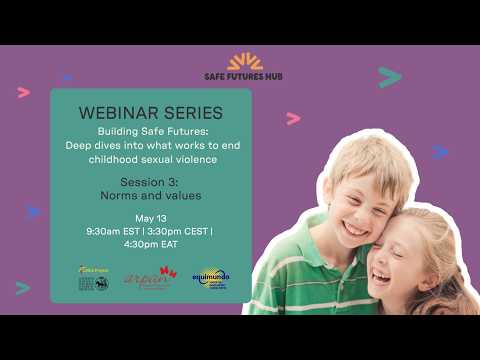
Session 3: Norms and values
The third session in the Building Safe Futures webinar series focuses on norms and values, and why they are central to preventing childhood sexual violence.
The Safe Futures Hub Evidence Review shows that prevention efforts are stronger when they directly challenge the norms and structures that enable abuse. Gender-transformative programs, structured community engagement, and bystander approaches can strengthen clear expectations around consent, equality, and responsibility. Interventions that actively involve caregivers, men and boys, faith leaders, and other community influencers help shift collective standards of behavior and reinforce accountability.
At the same time, changing norms is complex and takes time. Measuring progress is challenging, and there is still more to understand about how these efforts adapt across different contexts, including online spaces.
In this session, experts and practitioners share their experience from implementation, reflect on lessons learned, and speak to the gaps identified in the evidence. The webinar examines what has made norm-focused work effective in real settings, what obstacles continue to stand in the way, and what needs to shift to strengthen prevention efforts.
- Joan Njagi PhD, Child Sexual Violence Researcher, Sexual Violence Research Initiative (SVRI)
- Gary Barker PhD, President and CEO, Equimundo
- Dr. Manjeer Mukherjee, Senior Director of Strategy, ARPAN
- Dr. Ana Maria Buller, Associate Professor, London School of Hygiene and Tropical Medicine
Session 2: Education and life skills
The second session in the Building Safe Futures webinar series explores education as a critical pathway to preventing childhood sexual violence.
Evidence from the Building Safe Futures review highlights the impact of education-based interventions. Comprehensive sexuality education, life skills programmes, and school-based violence prevention initiatives are associated with improved understanding of consent, bodily autonomy, and healthy relationships.
At the same time, schools can also be sites of risk. Persistent challenges include peer and authority-perpetrated violence, weak safeguarding systems, and barriers to access for the most marginalized children.
This session shares the latest evidence, highlights promising practice-based approaches, and explores what it takes to make schools safer for all children. We look at where education systems are working well, where challenges remain, and what needs to change to strengthen prevention and response.
Speakers
- Patricia Cardona Roca – Brave Movement
- Dipak Naker – Coalition for Good Schools
- Abir Nur – Population Council
- Muhammad Atta – Right To Play
Moderator
- Manuela Balliet-Ahogo – Together for Girls
Presenter
- Constanza Ginestra – Together for Girls

Session 1: Parenting and caregiver support
The first session in the series focused on parenting and caregiver support, a cornerstone in preventing childhood sexual violence. The evidence is clear: when equipped with the right tools, parents and caregivers become powerful protectors, with ripple effects that can transform families and communities. The Building Safe Futures evidence review highlights parenting programmes as among the most effective interventions, showing measurable reductions in sexual violence when programmes are well designed and implemented.
This session shared the latest evidence, spotlighted effective interventions from the review, and opened space for dialogue on how to strengthen caregiver support worldwide. We will also reflect on what is missing, how to make these efforts more inclusive and where we need to go next.
Join us to explore how supporting parents and caregivers helps not only prevent harm, but build trust, resilience, and safe futures for all children.
Speakers
- Nicholas Makharashvili – Safe Futures Hub
- Prof. Jamie Lachman (CEO)– Parenting for Lifelong Health (PLH)
Panelists
- Dr Sangeeta Saxena – Girl’s Globe, India
- Beatrice Ogutu – Skillful Parenting Programme, Kenya
- Joyce Wamonyi – Parent App for Teens, Tanzania
- Prof. Lucie Cluver – Parent App for Teens, Tanzania
Moderators
- Dr Lina Digolo - Safe Futures Hub
- Dr Isang Awah - Global Parenting Initiative

Tags
Share your story!
Do you have a experience with the programs on this website, or any other interventions that aim to address or reduce childhood sexual violence?
Whether you're a advocate, activist, implementer or a participant of a program, we'd love to hear from you!